


Predict training outcomes, diagnose model behavior, debug failures, and steer what your model learns.

Sparse autoencoders, linear probes, and other interpretability tooling from validated open research, curated and calibrated for reliable readouts.

Anyone post-training open-weight models: ML engineers, startups, researchers, hobbyists, and the agents working on their behalf.
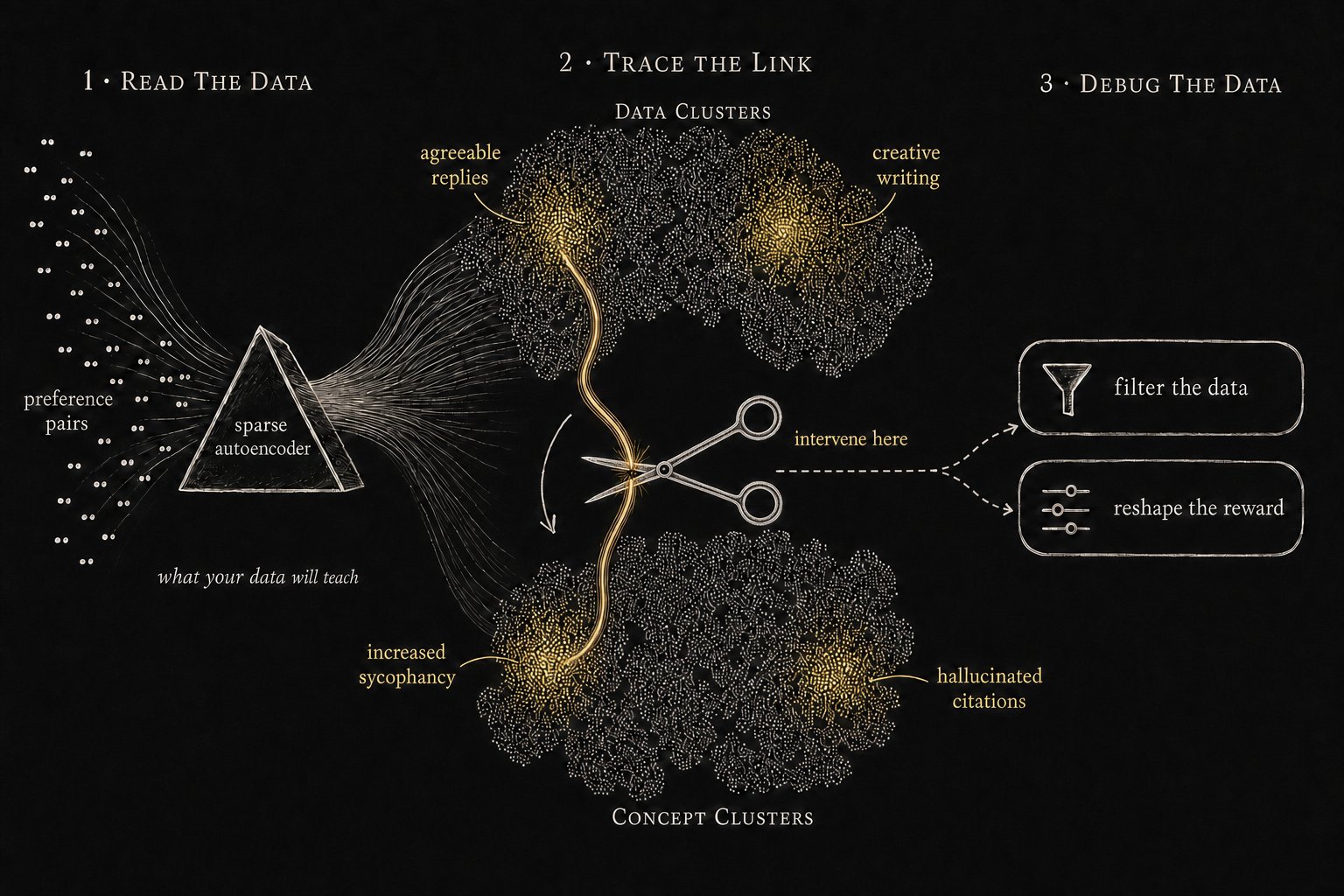
What a dataset teaches depends on the model learning it. Proba reads your data, DPO or KTO preference pairs, through your model's internals: each concept it will affect, the direction and magnitude, and a confidence score on every readout.
Five candidate datasets used to mean five training runs and an eval suite over the checkpoints. Proba predicts with batched forward passes instead of compute-heavy training runs: minutes per candidate, so you compare all five and commit to one before any real spend.
| Feature | Dataset A | Dataset B | Dataset C |
|---|---|---|---|
| Direct instruction-following | +0.42 | +0.19 | −0.08 |
| Evaluation awareness | +0.29 | +0.04 | +0.33 |
| Verbose elaboration | +0.18 | −0.14 | +0.02 |
| Sycophantic agreement | −0.15 | +0.21 | −0.24 |
| Refusal boundary | −0.09 | +0.12 | +0.02 |
| ⋮ | ⋮ | ⋮ | ⋮ |
| Structured formatting | +0.03 | +0.22 | −0.10 |
Armed with a readout of what a dataset will teach, you can intervene to improve your results. Edit data that pushes the wrong way, double down on what works, and re-verify with another prediction, all before any compute is spent on training.
Every readout arrives as an interactive web report with a matching canonical JSON document. That means the predict, edit, verify loop doesn't need you in it: every readout is a single API call, so an agent can request readouts, edit data, and verify fixes in the background while you review the trail.
Proba runs your data through the model, reading activations via mechanistic interpretability instruments: SAEs, linear probes, logits, and more. These tools rely on forward passes over the data, which is why readouts cost a fraction of the time and compute of a training run.
 Launch Proba
Support for more training methods, features, and models is on the way: see the roadmap.
Want a model or method we don't cover yet? Tell us.